People-Led Pathways to a Greener India
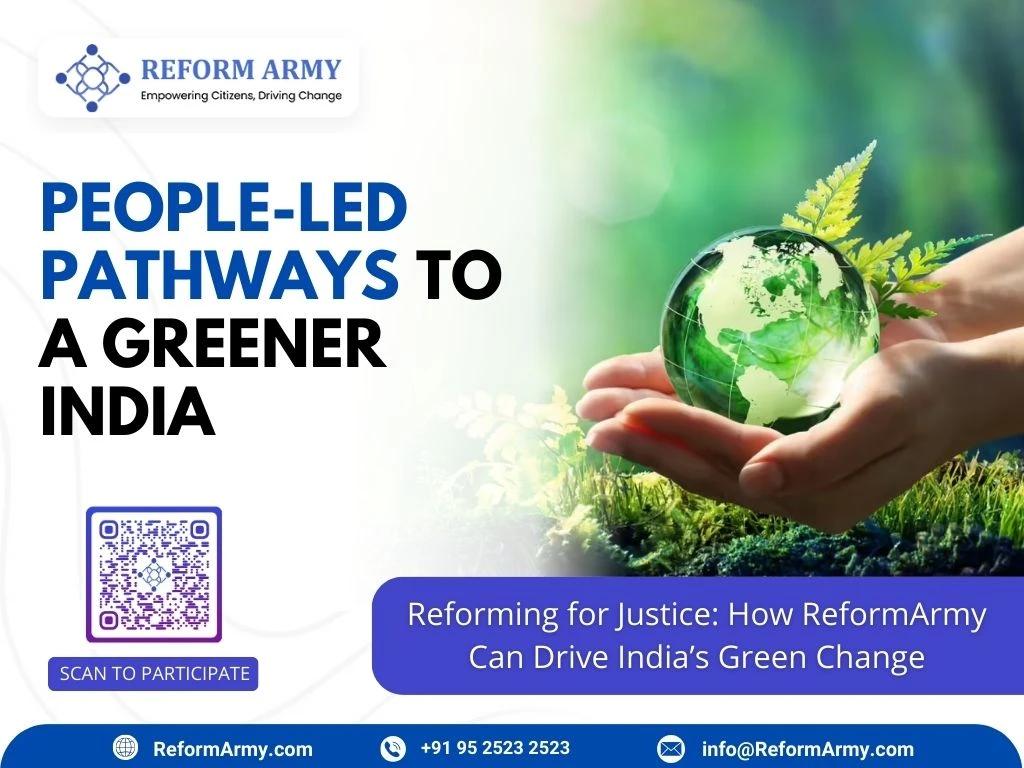
Reforming for Justice: How Reform Army Can Drive India’s Green Change
Law, Justice and the Right to a Healthy Environment
India’s environmental framework stands at a decisive moment. A recent judgement by the Supreme Court of India prohibiting post-facto environmental clearances has reinforced a critical principle: ecological safeguards cannot be treated as a procedural formality. Projects must comply before they begin, not after damage has already occurred. This shift strengthens accountability, yet it also raises complex questions about stalled infrastructure, employment concerns and the balance between economic growth and ecological protection.
At its core, environmental justice is about fairness. Every individual, regardless of geography or socio-economic status, has the right to clean air, safe water and a healthy natural environment. When rivers become polluted, forests disappear and air quality declines, it is often the most vulnerable communities that suffer first and most severely. Environmental degradation is therefore not only an ecological issue but also a social and ethical one.
Why This Moment Matters
India possesses a comprehensive set of environmental regulations. However, the challenge has rarely been legislation; it has been enforcement and public participation. Policies exist on paper, yet violations frequently go unreported, monitoring remains inconsistent and citizens often feel disconnected from decision-making processes.
This gap between law and implementation has allowed unsustainable practices to continue. Industrial discharge into water bodies, unchecked urban expansion and the gradual loss of green cover demonstrate how environmental governance weakens when accountability is limited to institutions alone. Sustainable progress requires active civic involvement alongside regulatory oversight.
Reform Army: Converting Awareness into Action
This is where Reform Army, an initiative of JJFIndia, offers a participatory approach to environmental reform. It seeks to make ecological accountability accessible to ordinary citizens by connecting communities, subject experts and institutions through structured engagement.
By enabling individuals to document environmental concerns, support local conservation efforts and contribute to policy dialogue, Reform Army transforms awareness into practical action. Citizens can track violations, advocate for compliance with environmental norms and collaborate on initiatives such as tree plantation, waste management and water conservation.
This approach is significant because environmental protection cannot be sustained through regulation alone. When communities are informed and organised, monitoring becomes continuous and local knowledge strengthens policy implementation. Civic participation also increases transparency, ensuring that development projects consider long-term ecological consequences rather than short-term gains.
Responsible Growth and Inclusive Governance
India’s path to sustainable development lies in integrating economic ambition with ecological responsibility. Development that undermines natural resources ultimately weakens public health, livelihoods and future productivity. Conversely, environmentally conscious planning creates resilient infrastructure, protects biodiversity and improves quality of life.
Reform Army promotes this balance by encouraging dialogue between citizens and decision-makers. It supports the idea that environmental governance should be inclusive, data-informed and locally responsive. When individuals see themselves as stakeholders in ecological protection, sustainability becomes a shared responsibility rather than an abstract policy objective.
Conclusion
India’s environmental future depends on bridging the gap between strong laws and effective implementation. Judicial decisions can set important precedents, but lasting change requires informed and active citizen participation. By enabling people to engage in monitoring, advocacy and local conservation efforts, Reform Army demonstrates how collective responsibility can strengthen environmental justice. Sustainable development will not be achieved by choosing between growth and ecology, but by ensuring that progress is guided by accountability, inclusivity and respect for the natural world.
MONTHLY MAGAZINE
Social media icons









© 2024 - 2026 ReformArmy.com - An Initiative by Jainam Jivika Foundation. All Rights Reserved.